
Published
Refinances produce a predictable conversation. The borrower has owned the property for nine years, nothing has been built, nothing has been spilled, and now a new lender wants environmental diligence. It feels like paperwork for its own sake, and the objection is usually framed as a question about the site. It is really a question about who is being asked to rely on the answer, which is the same distinction our note on environmental liens for lenders draws.
Why the question gets asked again
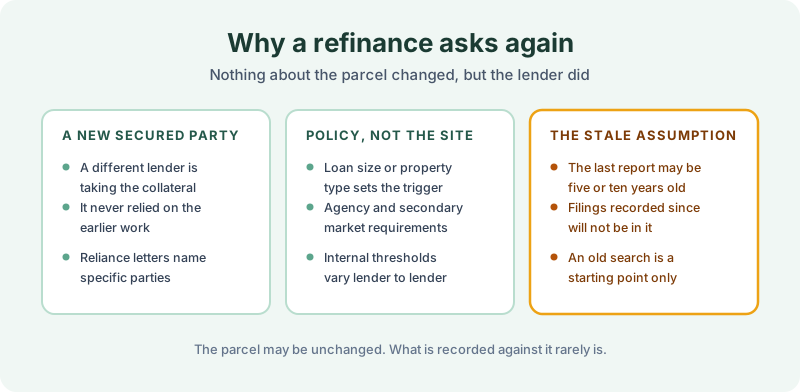
A different party is taking the collateral. The lender on the new loan did not commission the earlier work and was not named in it. Reliance runs to specified parties, so a report addressed to a bank that is being paid off does very little for the bank replacing it.
The trigger is policy rather than condition. Loan size, property type, agency requirements, and secondary market expectations set the threshold, and those thresholds vary from one institution to the next. A parcel that cleared diligence at one lender can fall inside another lender’s screening band without anything at the site having changed. The same thing happens in reverse when a property type moves between loan programs, so the absence of a request last time tells you very little about this time.
And the borrower’s mental model is usually stale. The last report may be five or ten years old. It reflects what was recorded as of its date, and it has nothing to say about anything filed since. That is not a criticism of the earlier work. Every records search is accurate as of a day, which is the point our note on the 180 day rule makes about the Phase I itself.
What can appear in the gap
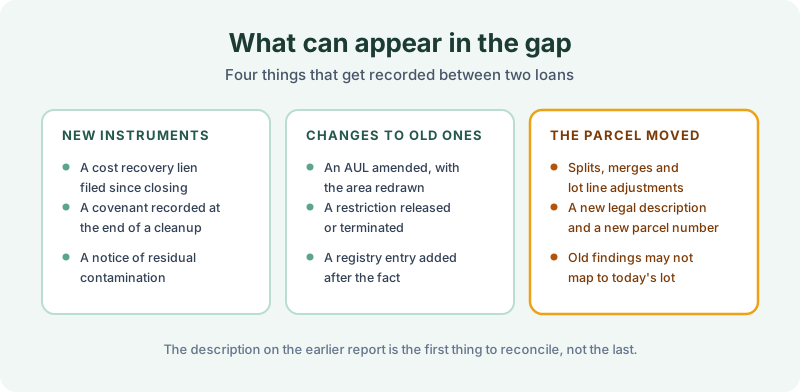
New instruments are the obvious category. A cost recovery lien filed after a state spent money nearby, a covenant recorded at the close of a cleanup, or a notice of residual contamination entered once an investigation wrapped up. Those are the instruments described in our note on environmental covenants and UECA.
Changes to existing filings are the quieter category. An activity and use limitation can be amended and its mapped area redrawn, a restriction can be released, and a state registry entry can be added long after the underlying event, which is why our note on institutional control registries treats the registry as a separate search from the recorder.
Then there is the parcel itself. Splits, merges, and lot line adjustments produce a new legal description and often a new parcel number, and findings written against the old description may not map cleanly onto the lot now being financed. On a refinance that is worth checking first rather than last, because it determines whether the earlier report is even about the same ground. Where a parcel has been subdivided since the last loan, the question our note on AULs when a parcel is subdivided raises applies directly, and the answer is rarely obvious from the face of the older document.
Scoping the search
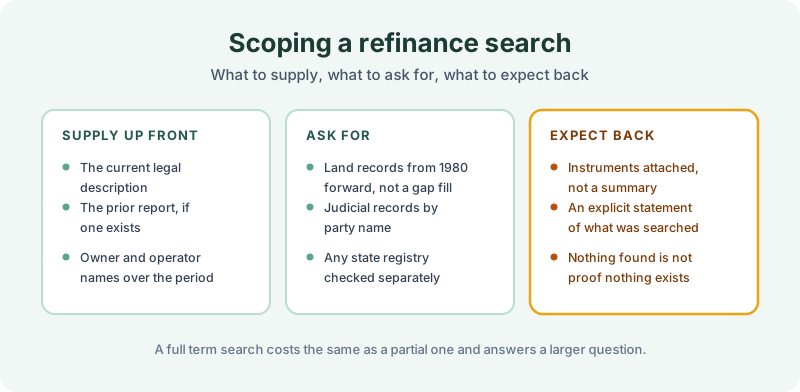
Supply the current legal description, the prior report if one exists, and the owner and operator names covering the period. On a tenanted property the operator names matter as much as the owner’s, for the reason our note on leased property sets out, and an enforcement action against a former tenant sits in a court index organized by party name rather than by parcel.
Ask for the full term rather than a gap fill. Searching only the years since the last report sounds efficient and is a false economy, because it inherits every assumption the earlier work made about indexing, name variants, and the description, and it costs about the same. A 1980 forward search stands on its own.
Expect the instruments themselves rather than a summary, and expect an explicit statement of what was searched. The FAQ covers how thin or unindexed counties are handled, and a sample report shows the format. Read the result for what it is. A search reports what was recorded and indexed over the term searched, so nothing found is not proof that nothing exists.
The 1980 Environmental Lien & AUL report is the record half of this work. Certified title abstractors review land title and judicial records from 1980 to the present and document every environmental lien, encumbrance, and AUL found, with the recorded instruments attached. It is $425, delivered by email in 3–5 business days. Order online, or start with our note on how the search is performed if you want the procedure first.
Get an E1527-21 compliant lien & AUL report
Our 1980 Environmental Lien & AUL reports are researched by certified title abstractors, cover judicial records, and are guaranteed accurate. Delivered in 3–5 business days.
or call 877-848-5337